Founder story

OmniBoard:
The Board Game Console That Didn't Pencil Out

I wanted to build a console for board games. Not an app. Not a tablet. A real device for the dining table. The vision worked. The BOM did not.

2026-05-13 14 min

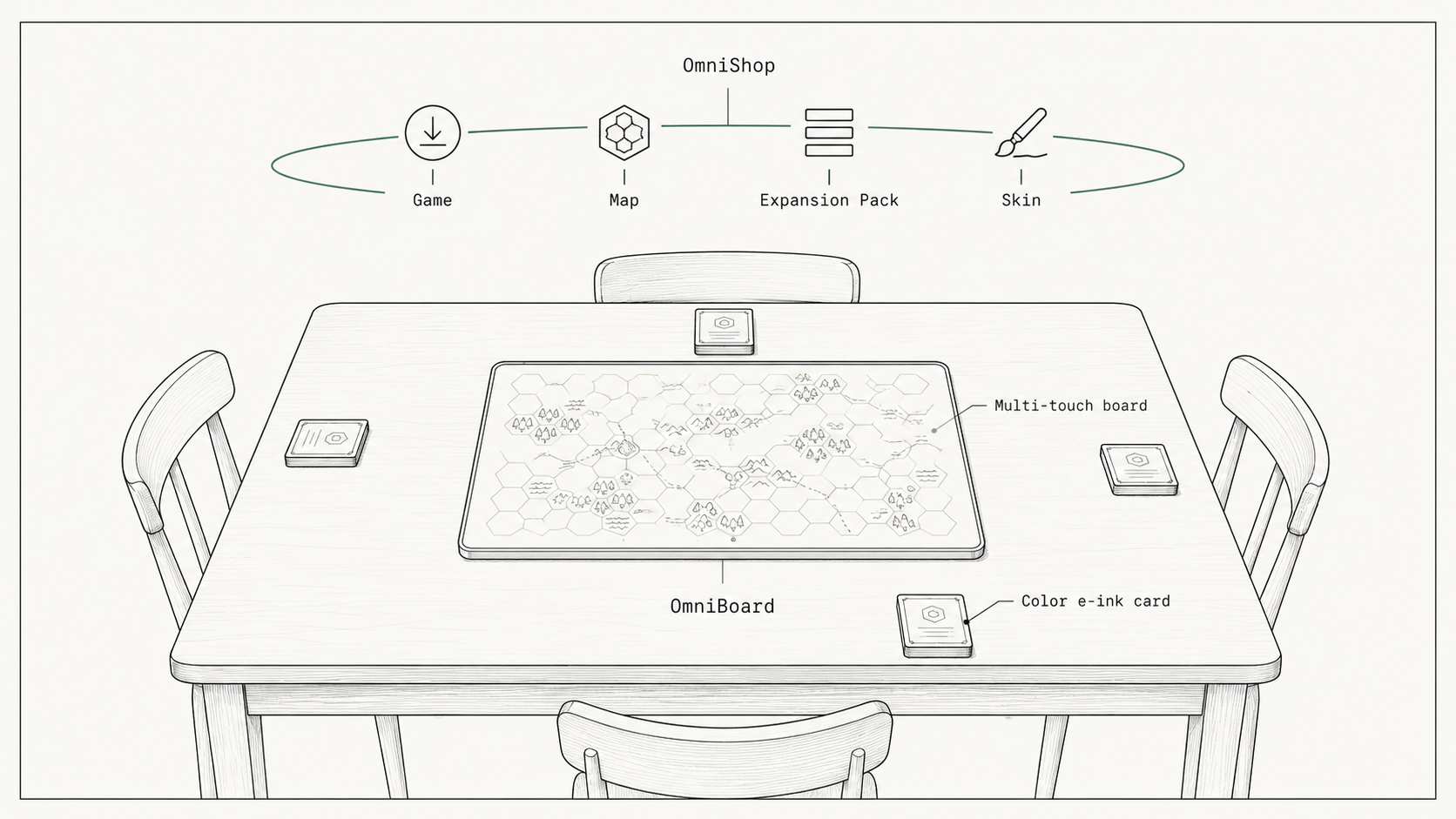
Schematic of OmniBoard sitting on a dining table. A multi-touch board carries a faint generic hex pattern. Four small card stacks surround the board, one per player position. A thin orbital arc above the table represents OmniShop with small icons for games, maps, expansions, and skins.
OmniBoard. A console for board games. The board on the table, the cards in your hand, the marketplace overhead.

Not an app. Not a tablet. Not a companion thing that lives next to a board game. A real device. The kind of thing that sits on the dining room table, and the table feels different because it is there.

A board in the middle. Physical cards in your hand. The cards are real - paper-like, lightweight, the same shape and weight as the cards in the box you grew up with. But every card can become any card. Catan tonight. UNO tomorrow. Cards Against Humanity after dinner with friends. A new indie game next week, downloaded in thirty seconds. Same hardware. Infinite games.

That was OmniBoard.

OmniBoard started as a side project in 2023, after SNDBOX was acquired and I finally had room to write in a notebook again. It was not a company on day one. It was one of those side projects that quietly turns serious - the kind that earns a P&L, a deck, three time zones of e-ink supplier calls, VC meetings, mechanics sketched on the back of envelopes, and a marketplace design. I worked on it, off and on, through most of 2023 and into 2024.

I shelved it because of one number, and that number is a real number, not a rhetorical one. I will get to it. But I do not want to start the post there. The math is the second half of the story. The first half is that this was a beautiful product and it deserved to exist.
What it felt like, on a Friday night

Picture the table.

Four people sitting around it. The board is a single multi-touch surface in the middle - a real, physical thing, the size of a small TV laid flat. It is currently a Catan map: hex tiles, numbers, ports, a robber. Tomorrow night the same surface will be a Monopoly board. The week after, a 2-player Go board for the kids. The board does not know what game it is, until the device tells it.

The cards are in your hand, where they belong. They feel like cards. Paper-like. Lightweight. No glowing rectangle, no glare, no battery drain you can see. Each card is a thin, flexible color e-ink panel - the same display family the Kindle uses, except now it does color, and now it has been miniaturized and embedded into a card-shaped object that lasts months between charges.

Between rounds, you put the cards face-down on the board, the device updates them in place, and the hand in your fingers is now a different game. Same five cards. Different deck.

The closet is empty. There is no shelf groaning under twenty board game boxes. There is no "wait, did we lose a card from this one?" There is no "the kids spilled juice on Settlers, that whole copy is done." There is one device, on the table, and the entire history of board gaming inside it.

That was the feeling I wanted the product to have. Less a gadget. More like the thing your family pulls out on a holiday and then keeps pulling out long after the holiday.

The vision sentence I kept coming back to was simple: the ultimate board game box for every household. Not "an app for board games." Not "a digital tabletop." A box. The box that replaces the closet.

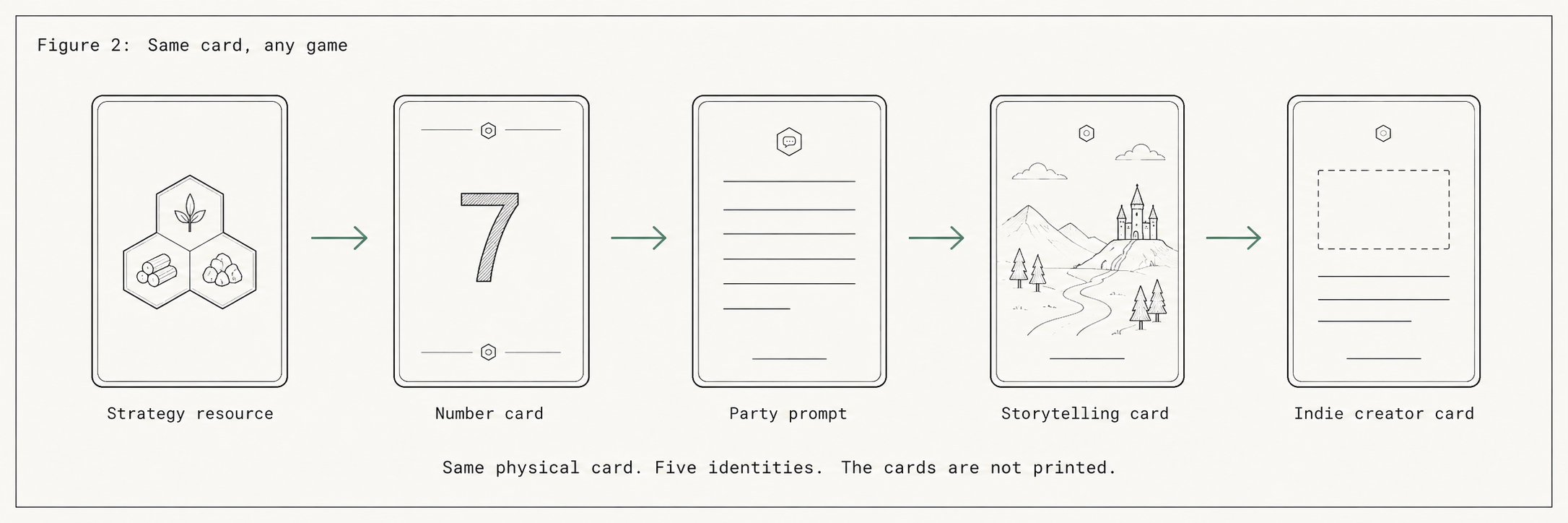
Same card, any game

A horizontal strip of five identical card outlines, each showing a different generic card identity, with sage-accent arrows between them indicating morphing.
Same physical card. Five identities. The cards are not printed.

The core magic of OmniBoard, the thing that made the rest of the platform possible, was that the cards were not printed.

A regular printed card has one job for life. It is the 7 of hearts. It will always be the 7 of hearts. Whatever game uses 7 of hearts, you can use it for. Whatever game does not, the card is dead weight in a drawer.

A flexible color e-ink card has no job until you give it one. The cards in the box are not a deck - they are a programmable substrate, and the deck is whatever the device decides it is between rounds. That is the move that makes everything else possible.

This is not a digitization story. Tabletop Simulator digitized board games and that is a fine product, but it stripped the table out and turned everything into a screen with a mouse. OmniBoard kept the table and made the cards programmable.

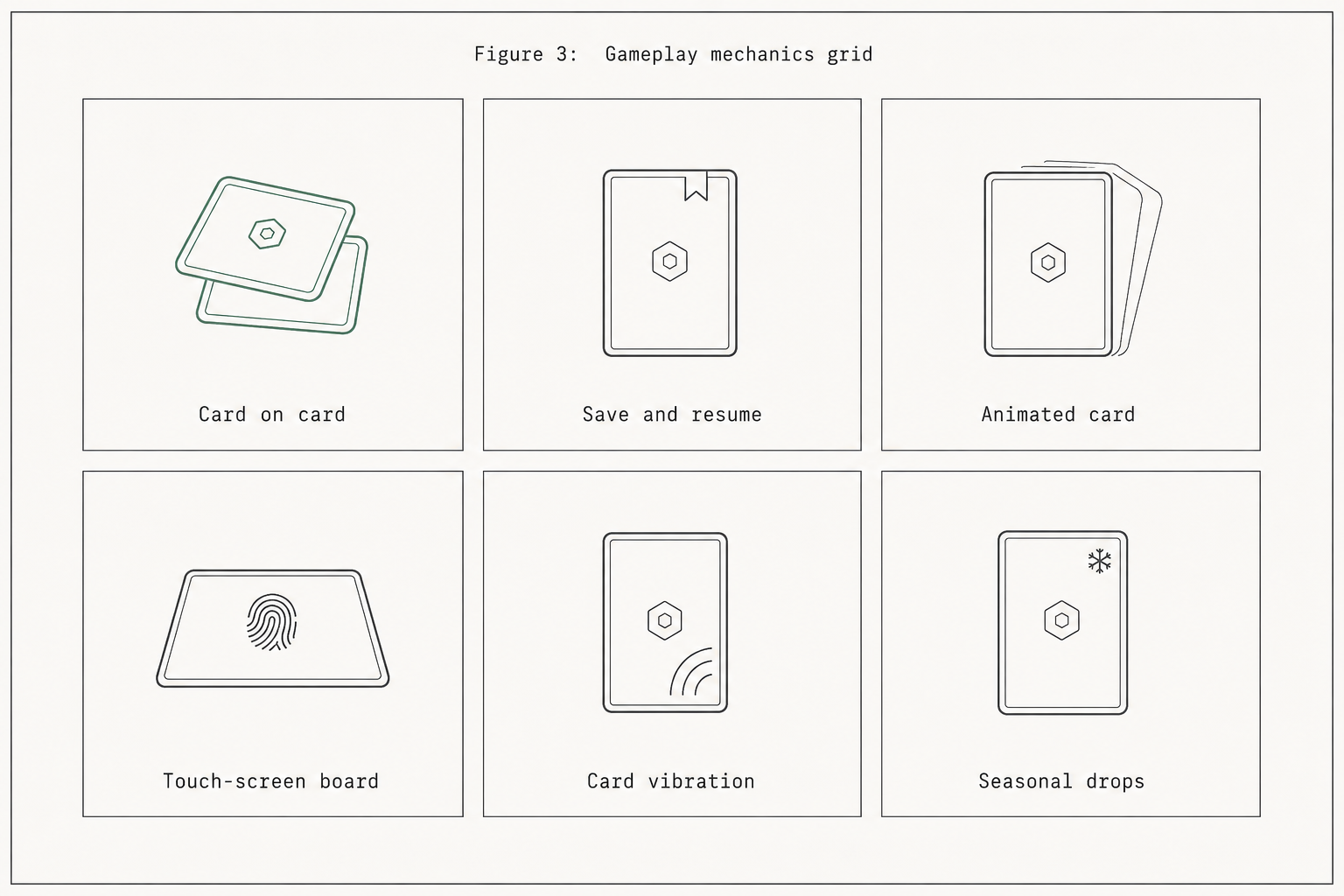
What that programmability unlocks is more important than the storage win. It is a new mechanic layer that printed cards cannot have:

  • The same hand of 5 cards can be 5 different things across 5 different games in the same evening.
  • One card can morph mid-game, in your hand, in front of you. Pick up a sword card, the card becomes the sword you are now holding.
  • A Dungeons and Dragons campaign saves its state to the card stack and resumes weeks later, where you left off, with the same hands you went to bed with.
  • A "card on card" gesture - placing one card on top of another - is now a real interaction the device understands. Armor on a character. Potion on a target. Two cards combine into a new card.
  • Cards can vibrate. Cards can be animated, gently, like the moving photograph on the Daily Prophet in Harry Potter. A creature card breathes. A weather card shimmers when it rains in-game.

None of this is the device showing off. All of it is mechanics that, today, simply cannot exist in a printed board game.

A 2x3 grid of six fine-line icons representing new gameplay mechanics: card on card, save and resume, animated card, touch-screen board, card vibration, and seasonal drops.
Six mechanics that printed cards cannot do. Card on card is the strongest read.

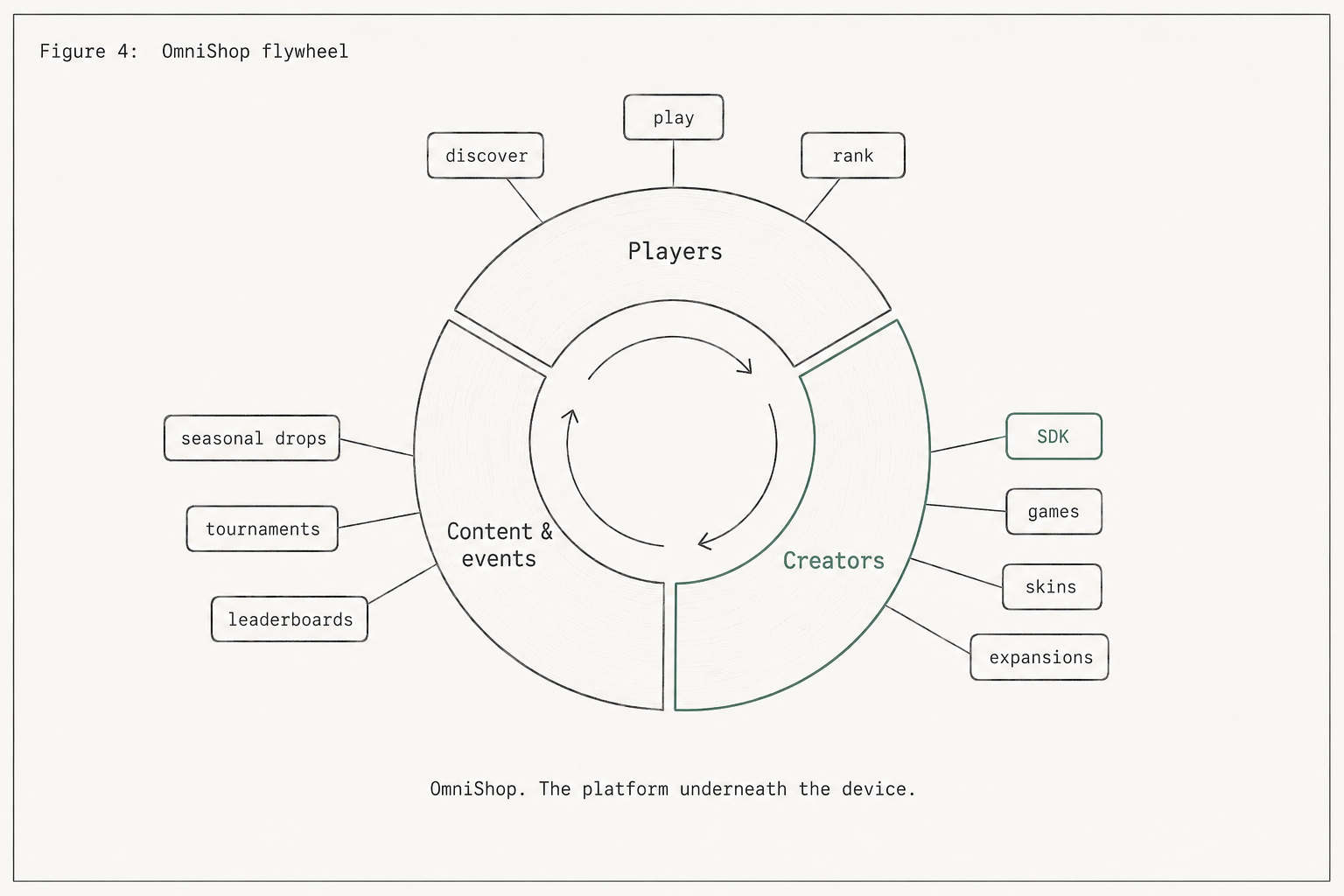
OmniShop, the platform underneath

A circular flywheel diagram with three arcs labeled Players, Creators, and Content and Events, with chip-style labels around the rim listing platform offerings.
OmniShop. The platform underneath the device.

The bet was not only the device. The bet was that board games were missing their platform.

PCs got Steam. Phones got the App Store. Living rooms got PlayStation and Xbox. Every one of them is the same shape: a hardware base, a content marketplace, a creator economy, a subscription, a community. Board games never got that shape. They still ship by truck. Steam releases tens of thousands of new games every year, while a tabletop release takes a year of manufacturing before it reaches a single player.

OmniShop was the missing storefront. It would have sold:

  • Games. First-party titles, licensed classics, indie originals.
  • Maps. Alternative Catan boards. New Monopoly cities. Custom worlds for the same game engine.
  • Card skins. New art for an existing deck. A seasonal skin for a party game. A winter-themed deck for a family card game. A custom-illustrated skin for a storytelling game.
  • Expansion packs. New rules, new cards, new mechanics dropped into a game you already own.
  • Seasonal and event drops. Limited-time content on holidays, tournaments, themed nights.

A creator SDK would let developers, designers, therapists, and teachers ship card-shaped products without ever touching a printer, a packaging line, or a freight container. A game on OmniBoard would be a download. That opens the door for the creators who get scared off by manufacturing risk today - the next Inscryption, the next Slay the Spire, a therapy deck for verbal-difficulty kids, a Spanish vocabulary trainer, a party game written by one person on a weekend.

The subscription rhymed with PlayStation Plus and Game Pass: $5 a month, one free game a month, free skins, ranked online play, seasonal events.

The line at the top of the investor deck was one sentence: OmniBoard is to board games what Steam is to PC games and what PlayStation is to the living room. Same shape. Different table.

Why board games needed this

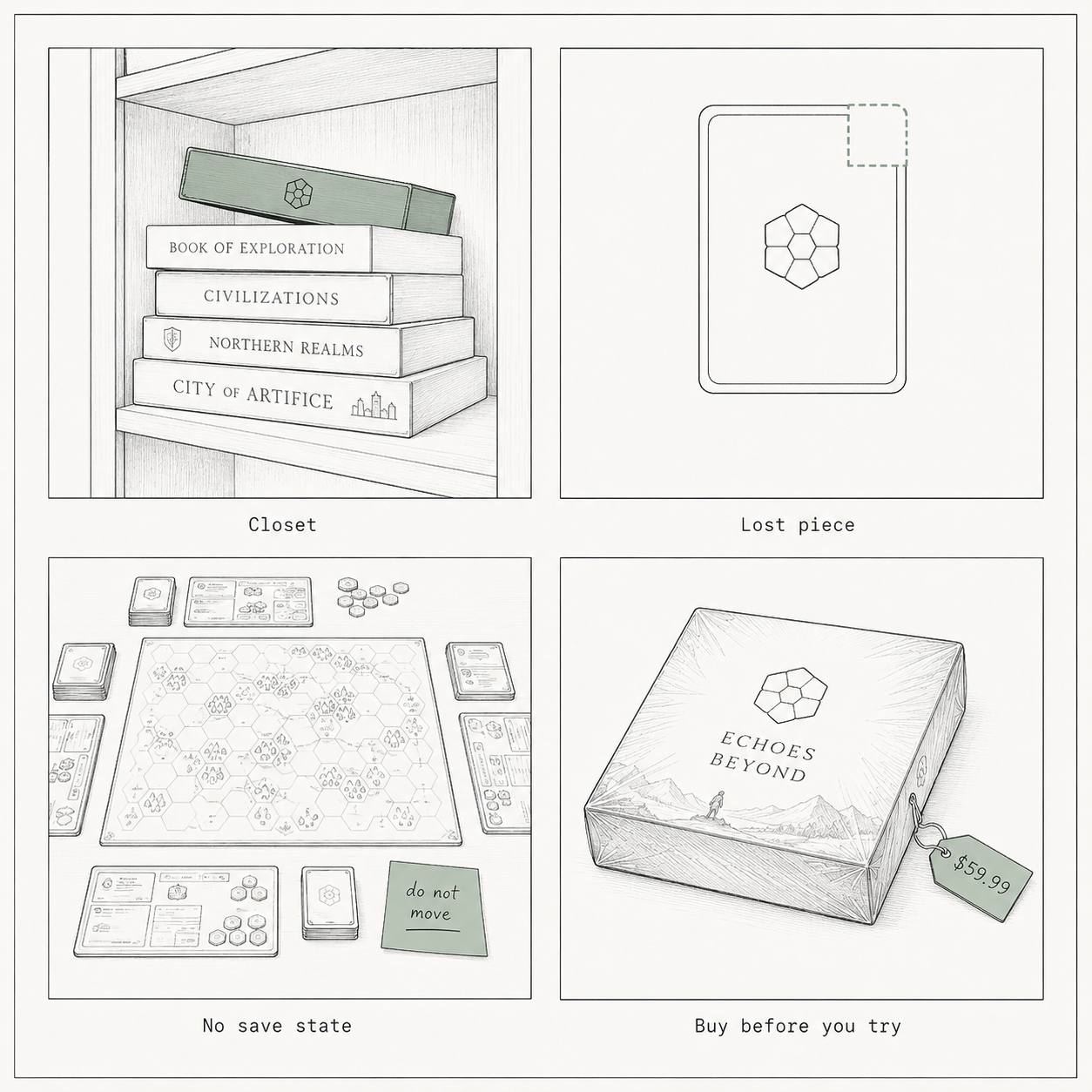
A 2x2 grid of four illustrated panels showing the everyday friction of board gaming: a closet of stacked boxes, a card with a missing-piece outline, a board mid-play with a do-not-move sticky note, and a shrink-wrapped box with a price tag.
The friction nobody talks about because it is everyone's normal.

I want to be careful not to oversell the pain side. Board games are not a broken category. They are one of the most enduring forms of social play we have. People love them. The category is growing.

But the friction is real, and it is the friction nobody talks about because it is everyone's normal:

  • The closet groans. A serious household has 20+ boxes, most of them rarely played, all of them taking shelf space.
  • Pieces and cards go missing. Nobody thinks a missing card matters until it is the one everyone remembers from the box.
  • Try-before-you-buy does not exist. You pay full price for a game, open the shrink wrap, find out in twenty minutes whether your group likes it, and if they do not, the box goes on the shelf forever.
  • Long games have no save state. A four-hour D&D session, a serious Risk campaign, a Catan game that ran late - if you cannot finish it tonight, the game is over.
  • Creators hit a wall. If you have a card game idea today and you are not a publisher, you cannot ship it. Manufacturing, packaging, shipping, and retail are four separate moats, each one capable of killing the project alone.

OmniBoard solved all of these as a side effect. Not as features. As a side effect of "the box replaces the closet, and the closet was always the actual problem."

Why I believed the market was real

I will not bury you in numbers, because the deck does that and most of the deck numbers are not the point of this post. But the headlines are worth knowing, because they are why I took the project seriously enough to spend a year on it.

Hundreds of millions of people play board games. The global board and card game market is somewhere in the tens of billions of dollars annually and projected to grow at a high single-digit to low double-digit CAGR through 2030, depending on which analyst you read. The methodology spread is wide - estimates put 2030 between roughly $22B and $40B - but the direction is unambiguous: the category is growing, not shrinking.

The thing that mattered for a platform play was the revenue concentration. A small number of titles do most of the money. Magic is now a billion-dollar-scale franchise and Hasbro's primary growth engine. A short list of category leaders - the trading-card games, the household party titles, the gateway strategy games - dominates revenue, which means a small number of high-leverage partnerships could ship the device with the games people actually want on day one.

Every other category of game has its platform. Tabletop does not. Somebody was going to build it.

I thought it could be me.

What I actually did

I want to be specific about the work, because "I had an idea once" and "I worked on this for a year" are different sentences.

I wrote the vision deck. I wrote the business deck. I wrote a customer-validation deck. I built the P&L, the operating model, and the funding story.

I also met dozens of potential co-founders. That part surprised me. OmniBoard was easy to explain and easy to fall in love with; once people understood the device and the platform, many wanted to jump onboard.

I called e-ink suppliers. DASUNG. eink.com. Ron Mertens at Metalgrass. DASUNG eventually told me to skip them and go straight to the manufacturers, which was good advice and also the first real signal: this is not a market that wants startups in it.

I started game-licensor outreach. A few committed conversations with publishers behind well-known card and party games. None of these were committed deals. Early signal-gathering.

I came from a very different startup world. Most of the investors I knew were B2B people, and many were connected to security. Consumer hardware was not the obvious next company for me. It almost felt out of reach. What surprised me was that when I told the OmniBoard story, people still leaned in. Even VCs who did not usually do B2C were curious enough to keep listening. The missing piece, before the BOM killed the project, was a small PoC - something physical enough to prove that the magic could exist on a table.

The pattern in the room, when people did pause, was not "the idea is bad." It was "hardware plus platform plus content is three startups stapled together, and a $10M seed gets you one."

I scoped the GTM: PAX Unplugged, Gen Con, Essen Spiel, UK Games Expo, Reddit /r/boardgames, BoardGameGeek, live testing at local stores.

The competition was real and not encouraging. The Last Gameboard raised a $4M seed in 2021. Magicyard raised $3.3M in 2022. A Riot-adjacent investment in this space flopped publicly. The graveyard for "digital board game device" is not empty.

Through all of this I had an open spreadsheet on the side, and I was filling it in as the vendor calls came back.

And then I opened the spreadsheet

I had been doing the work in the order founders are supposed to do it. Vision first. Decks. Conversations. Validation. Suppliers. VCs. The math last, almost as a formality, almost as a victory lap.

The spreadsheet was supposed to confirm what I already believed.

It did the opposite.

The number that killed it

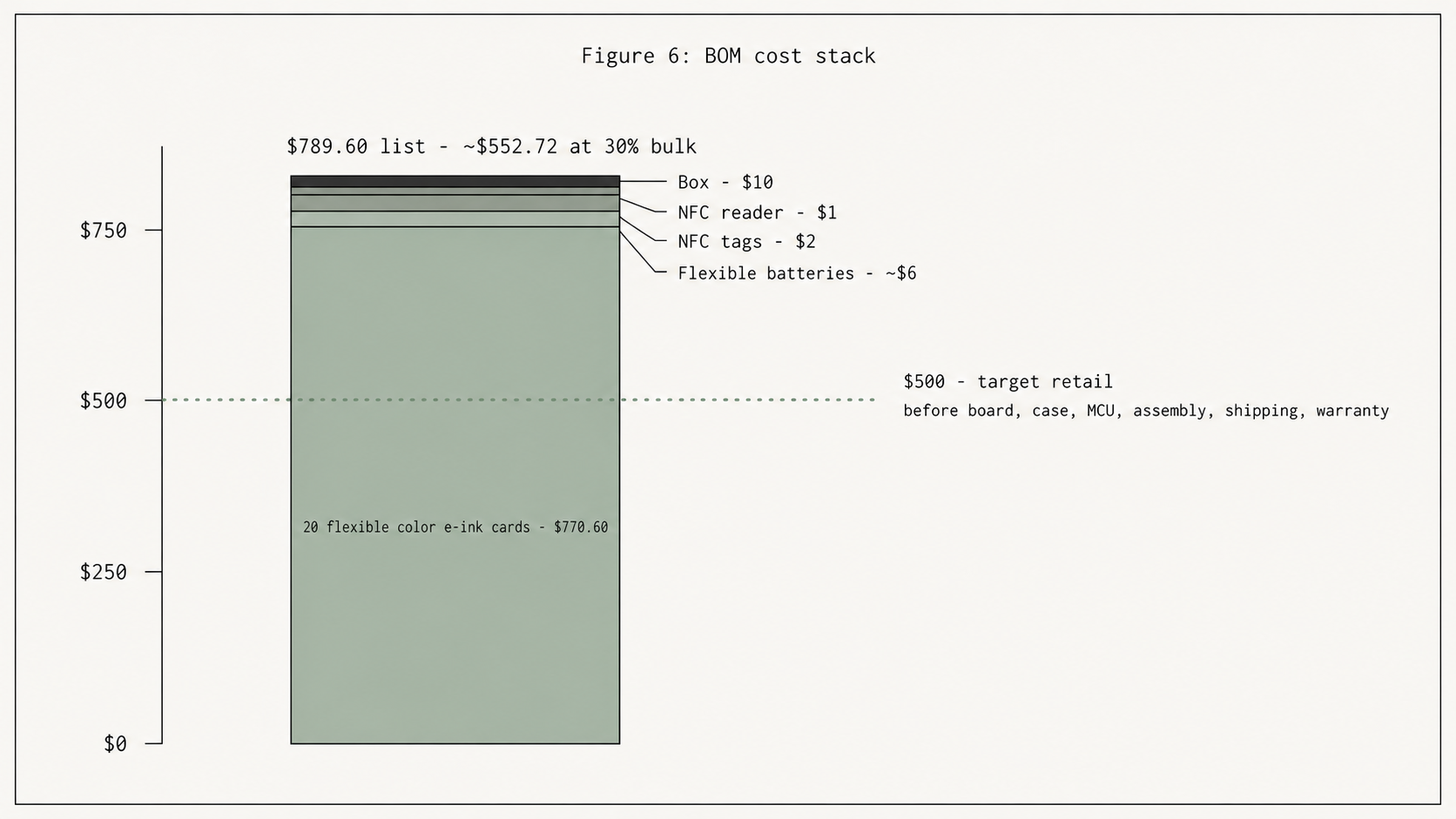
A vertical stacked bar chart with a sage-filled block dominating the bar labeled twenty flexible color e-ink cards at $770.60, with a horizontal sage-dotted line at the $500 target retail price sitting well below the bar.
Per-console BOM at 5,000-unit bulk pricing. The dotted line is the target retail price.

The BOM I built around the 5.65 inch flexible 7-color e-ink cards looked like this:

ItemUnitQtySubtotal
Flexible color e-ink card (5.65", 7-color)$38.5320$770.60
Flexible battery~$0.3020~$6.00
NFC tag$0.1020$2.00
NFC reader$1.001$1.00
Physical box$10.001$10.00
Per-console BOM (list)$789.60

At a rough 30% bulk discount on a 5,000-unit run, that drops to about $553 per console. Just the parts. Before the multi-touch board, the case, the MCU, assembly, shipping, warranty, and the cost of money. Realistic landed cost, all-in, was higher.

I had targeted $500 retail to stay below the PS5's $700. At $500 retail, every console would ship at roughly a $53 loss before any margin. The model only worked if a SaaS subscription at $5 a month and an average of five DLC games at $20 each subsidized the hardware loss, and that subsidy only crossed into profit at roughly a million units shipped.

To ship this honestly, I would have needed to retail it above $600. Probably north of $700. For a game-night accessory.

I went back to the notebook page where I had been keeping the kill criterion. The line on it was:

I ask myself, will I buy this for $1,000? My answer is no.

If I would not buy it, I should not ship it. The spreadsheet did what spreadsheets are supposed to do.

What would need to be true

For OmniBoard to actually work, one of three things has to happen:

  1. Flexible color e-ink prices fall by 60% or more. The 5.65 inch 7-color panel I priced at $38.53 bulk would need to land below $15 to make a $500 console work without subsidy. TVs got 50x cheaper from 1972 to today. The same curve will eventually run through e-ink. It will not run through it on a startup's timeline.
  2. A larger company subsidizes the hardware. The Steam, PlayStation, and Game Pass models all use the device as a wedge for the marketplace, and they tolerate hardware losses because the platform pays them back. That posture needs platform-company balance sheets, not a $10M seed.
  3. A cheaper card substrate appears. Reflective LCDs at the right quality. MicroLED tiles cheap enough to ship 20 per device. Something not on the 2024 roadmap that I am not aware of.

None of those three were true in 2024. I could not move the e-ink suppliers. I could not justify $700+ retail. And no alternative substrate showed up at the quality the product needed.

What I learned

The kill criterion has to be a number, written down, before you start. Mine was $1,000. The number is what made it possible to stop without negotiating with myself for another year.

Hardware plus platform plus content is three startups. A $10M seed funds one of them, well. It does not fund all three. If I do a hardware play again, I will pick the smallest viable shape - hardware alone, or platform alone, never all three at once.

Supplier conversations teach more than spec sheets. DASUNG telling me to skip them and go direct was the whole signal. Flexible color e-ink is not yet a market that wants startups in it.

Subsidy models need scale you can credibly hit. "Lose on hardware, win on SaaS and DLC" is a real strategy, but only if the unit economics flip well before a million units. Mine flipped at a million.

Validation is permission, not pull. People liked OmniBoard. Investors said complimentary things. Nobody pushed back hard. That is not the same as a market pulling on you.

Closing

Some ideas fail because they are wrong. OmniBoard is not one of those.

Some ideas fail because the world is not cheap enough yet. OmniBoard is one of those.

The device should exist. A console-shaped product will eventually change how households play board games the same way the Switch changed how households play video games. The economics moved 50x for TVs over fifty years. They will move for flexible color e-ink too.

For now, OmniShop, the SDK, the multi-touch board, the card-on-card mechanics, the morphing card in your hand - all of it is back in the notebook. Intact. Waiting.

When the BOM moves, the project moves with it.